

Case study
AI SaaS Product
Chapbook — AI Writing Studio for Nonfiction Books
An in-house product that turns a one-paragraph brief into a typeset nonfiction ebook — guided outline, chapter-by-chapter drafting in the author's voice, an AI or uploaded cover, and exports to digital PDF, EPUB 3 and a print-ready cover — with fixed credit pricing shown before every action.
At a glance
17 technologies · 4 outcomes captured below
Case Study
AI SaaS Product
Context
AI SaaS Product
Focused product scope with measurable operational and user-facing outcomes.
Technologies Used
Problem Space
The Challenge
Solopreneurs and business creators need lead magnets, workbooks and short nonfiction books to sell or grow an audience, but general-purpose AI chat tools produce unstructured text, lose the thread over tens of thousands of words, and leave the author to handle typesetting, covers, file formats and publishing checklists alone. Pricing is usually opaque too — users learn the cost after the work is done.
Delivery Response
Our Solution
BrilliMinds built Chapbook as a product: an agent-driven studio that plans an outline the author approves, drafts each chapter against it in the author's voice, reviews the manuscript for unsupported claims, broken citations and contradictions, and ships real artefacts — a typeset PDF, an EPUB 3, a KDP-sized cover and a launch kit. Every action shows its credit price up front, short output is refunded, and the author owns the manuscript, cover and exports outright.
Inside the Build
The product goals, delivery process, users, design direction, and outcome
This section walks through what the product needed to solve, how it was delivered, who it serves, and what changed after launch.
Goals
Chapbook is a BrilliMinds product for business creators and nonfiction authors: a paragraph in, a typeset book out. It covers three project types — lead magnets (1,000–10,000 words), workbooks (1,000–20,000 words) and nonfiction books (5,000–40,000 words) — and takes the author from brief to a finished, exportable book without leaving the studio.
- Keep the author in charge: they write the brief, approve the outline and edit every chapter, while the agent does the drafting, reviewing and formatting.
- Show the artefact, not promises: a free outline and sample chapter before any payment, real rendered books as proof, and exports the author owns outright.
- Make every cost known before it is spent — fixed credit prices displayed before each action, with refunds when the output comes in short.
Process
- 01
Product shaping and the manuscript model
The team started from the publishing pipeline rather than the chat interface. Semantic Markdown was chosen as the canonical manuscript format, converted by Pandoc to Typst for the PDF and to EPUB 3 for e-readers, so the same source produces every export. Project types, word ranges, credit prices and plan limits were placed in a single shared catalogue used by the server, the web app and the marketing site, so no price is ever hardcoded in a screen.
- 02
Agent workflow and the book editor
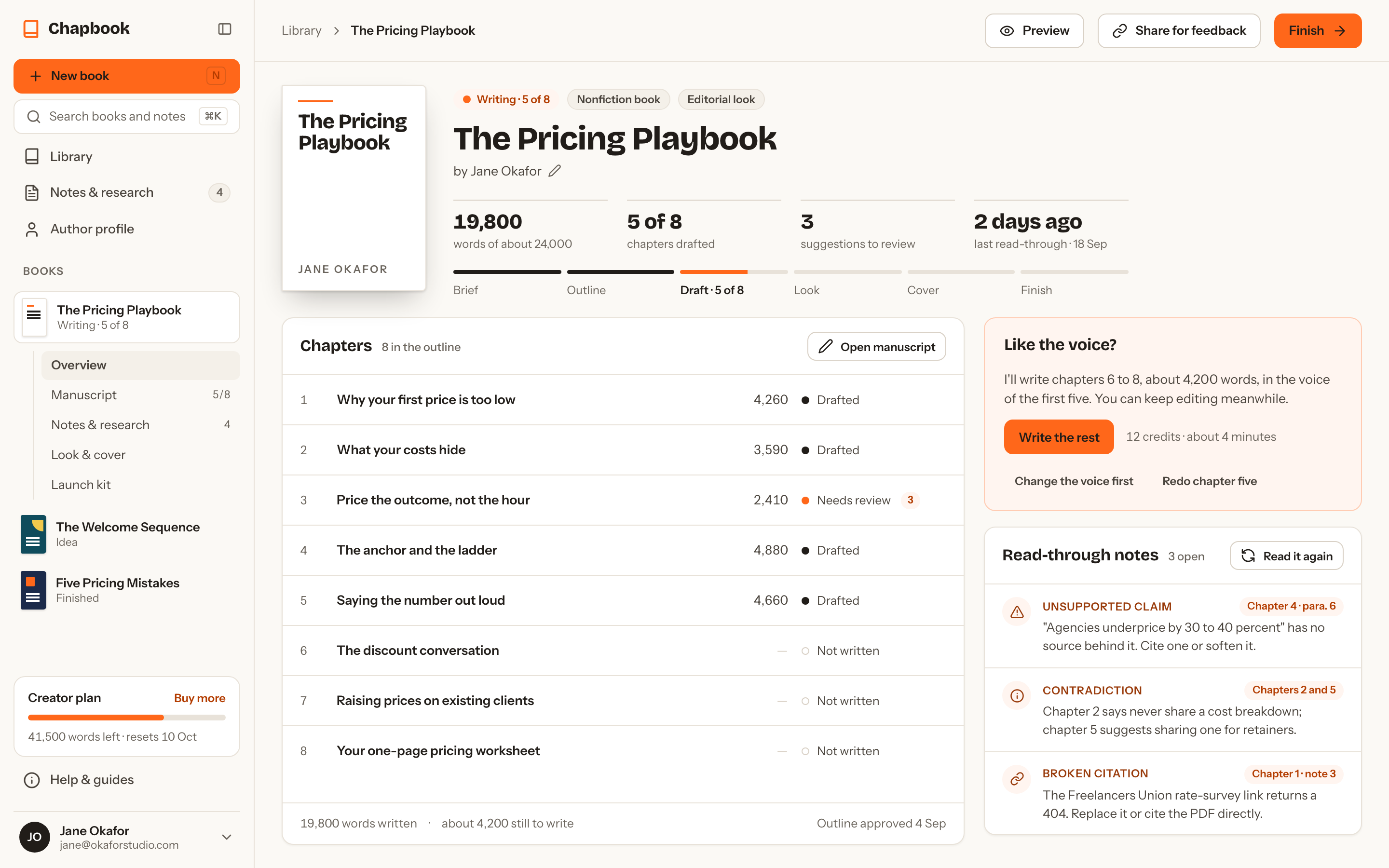
A Mastra-based agent on a Hono server runs the long-running jobs: outline generation, chapter drafting against the approved outline, read-throughs that flag unsupported claims and contradictions, cover generation and export. The React web app presents this as a guided book editor with a chapter list, a manuscript view set in a book typeface, and an assistant panel where the author asks for changes scoped to the current chapter. Up to five writing samples teach the agent the author's voice, and a saved "brand look" lets every new book start from the author's chosen typography and accent.
- 03
Credits, billing and trust features
Credit pricing is computed and displayed before each action runs; jobs that return fewer words than promised refund the difference automatically. Beyond the core loop, the team built a launch kit (store description, keywords, categories and ready-to-paste announcements), per-venue publishing checklists, share-for-feedback links that open a read-only copy to beta readers without an account, public book pages with reader sign-up, a notes and research library, and a cross-book search.
- 04
Deployment and launch
The web app and the Astro marketing site deploy to Cloudflare Pages, the API and job worker run in Docker on Coolify with PostgreSQL and S3-compatible storage, and sample-book page renders are served from Cloudflare R2. Six real generated sample books were produced end to end as launch proof, each with downloadable PDF, EPUB and cover.
Product Users
Authors — solopreneurs, coaches, consultants and creators — are the primary users. They write a brief, approve an outline, read the free sample chapter, and then decide whether to have the rest drafted, editing chapters in the manuscript view as they go. Beta readers open a share link to read the book text, look and cover without creating an account. Readers find a paid author's public book page, sign up for updates and download the book, landing in the author's own readers list.
Chapbook's own team uses an admin area for users, credit grants, billing and job health, and relies on the shared plan catalogue to change pricing in one place.
Design Direction
The identity is warm paper, warm ink and a single brand orange: a calm, precise instrument rather than a chat toy. Bricolage Grotesque carries headlines, Instrument Sans handles interface text, and EB Garamond is reserved for the manuscript itself, so the book always looks like a book while it is being written. Layouts use generous whitespace, real artefacts as proof — cover thumbnails, page previews, sample books — and subtle motion.
Functionally, the studio is organised around the book's stages — brief, outline, draft, look, cover, finish — with a persistent progress strip, per-chapter status, and an assistant panel that stays scoped to what the author is looking at. Credit prices sit directly on the buttons that spend them. Both light and dark themes were built as full themes, and the app remains usable on a phone for reviewing and light editing.
Outcome
Chapbook launched at chapbook.ink as a complete writing and publishing studio: outline-first drafting up to 40,000 words, manuscript review, three export formats from one source, a launch kit, feedback sharing and public book pages — all with transparent credit pricing and a free sample before payment. The product reuses the agent, auth and deployment architecture proven on pdfs.build, and its shared plan catalogue means pricing, limits and marketing copy can never drift apart.
Visual Support
Project Gallery
Screens from the delivered product, shown the way its users see them.
Web & desktop
Measured impact
Results & Impact
Outcomes we track with clients—numbers where they matter, clarity everywhere else.
Books up to 40,000 words drafted chapter by chapter against an approved outline
3
export formats — digital PDF, EPUB 3 and a 1600×2560 KDP cover — from one Markdown manuscript
Free outline and sample chapter before any payment, with credits refunded on short output
Manuscript review that flags unsupported claims, broken citations and contradictions
Have a similar project?
Contact usMore Projects
View all projects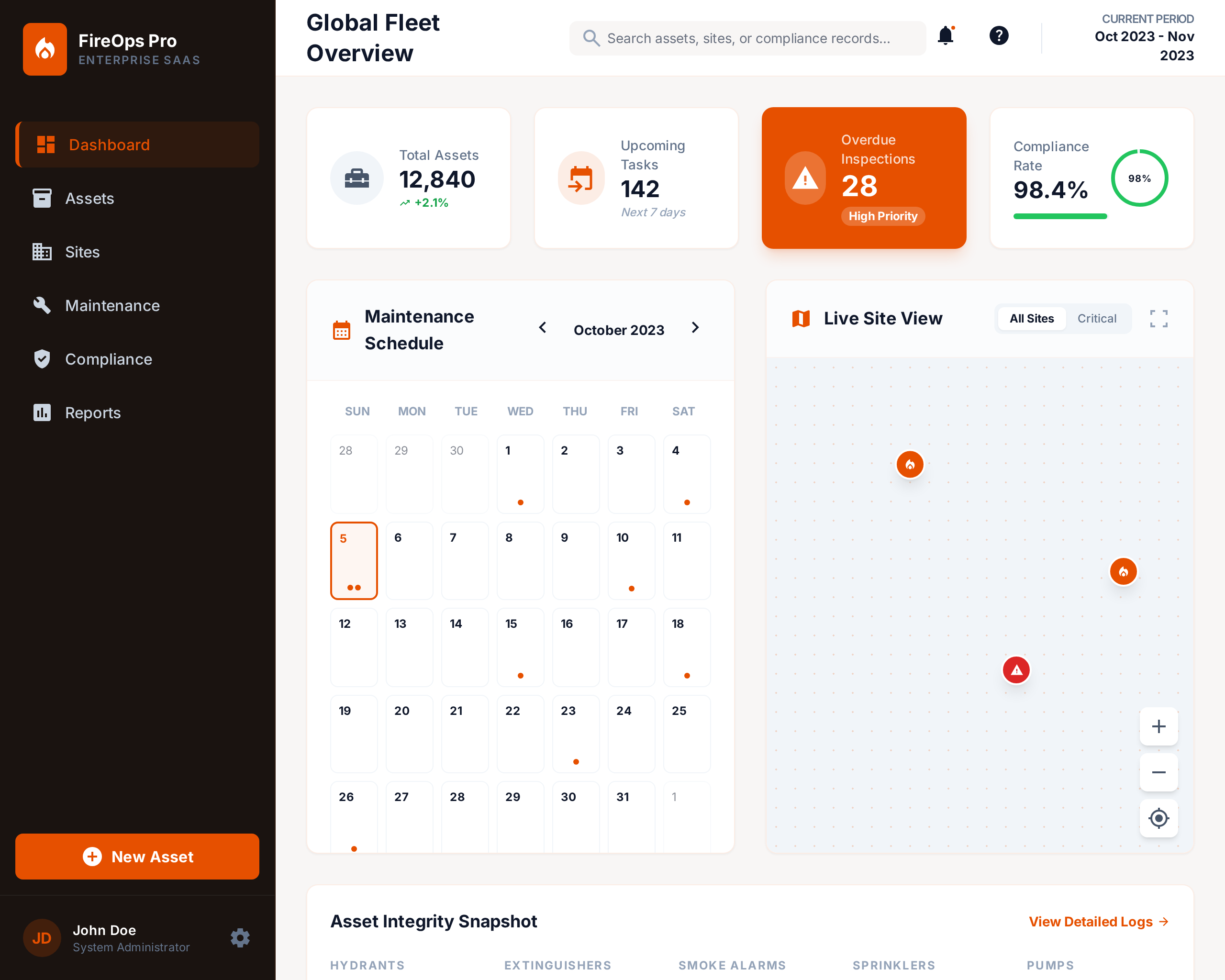
Fire Maintenance Management System
A comprehensive platform that helps fire maintenance companies organize operations, manage recurring orders, and track t...

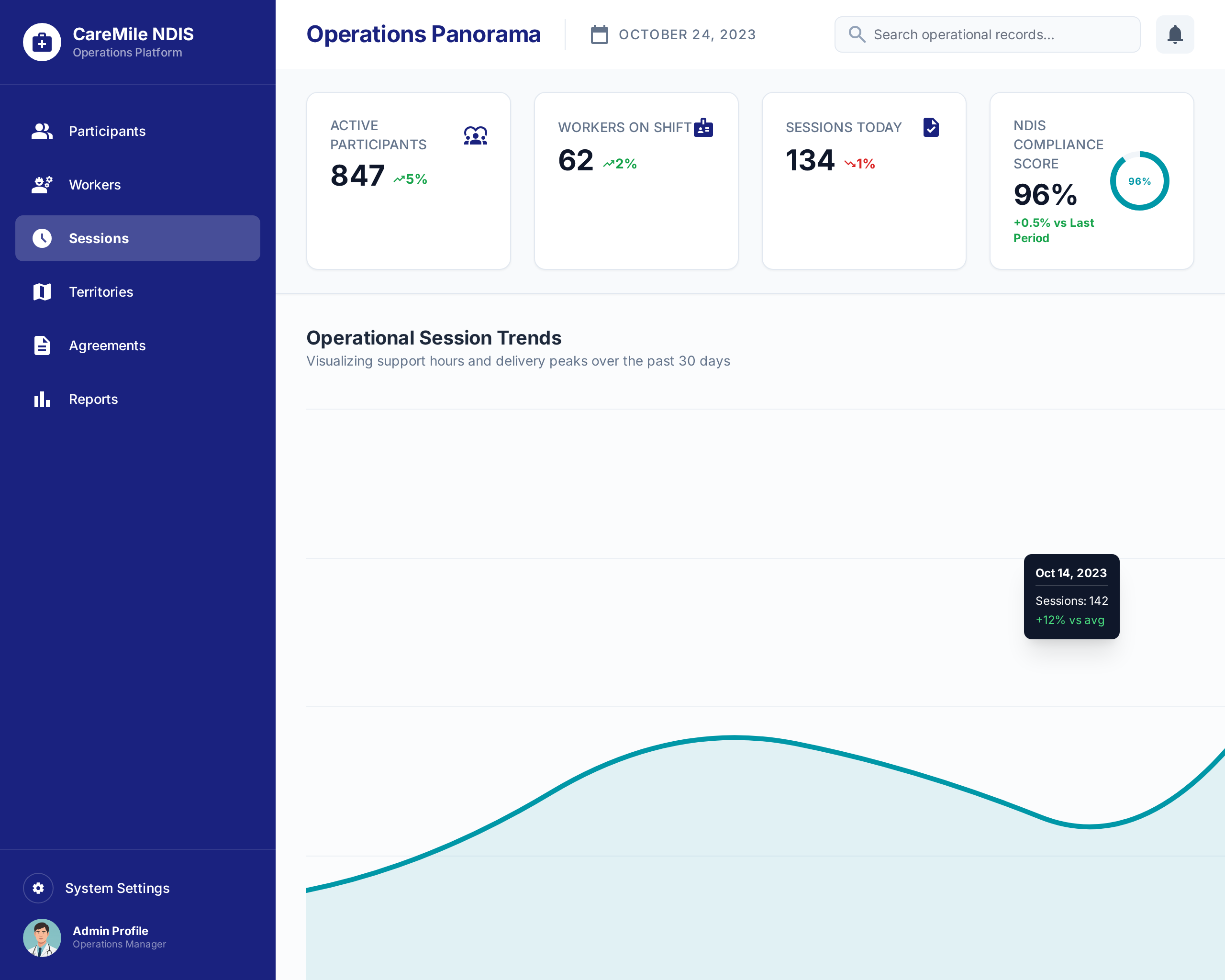
CareMile NDIS Operations Platform
A 42-module Odoo-based operations platform built for an Australian NDIS disability support provider to manage participan...
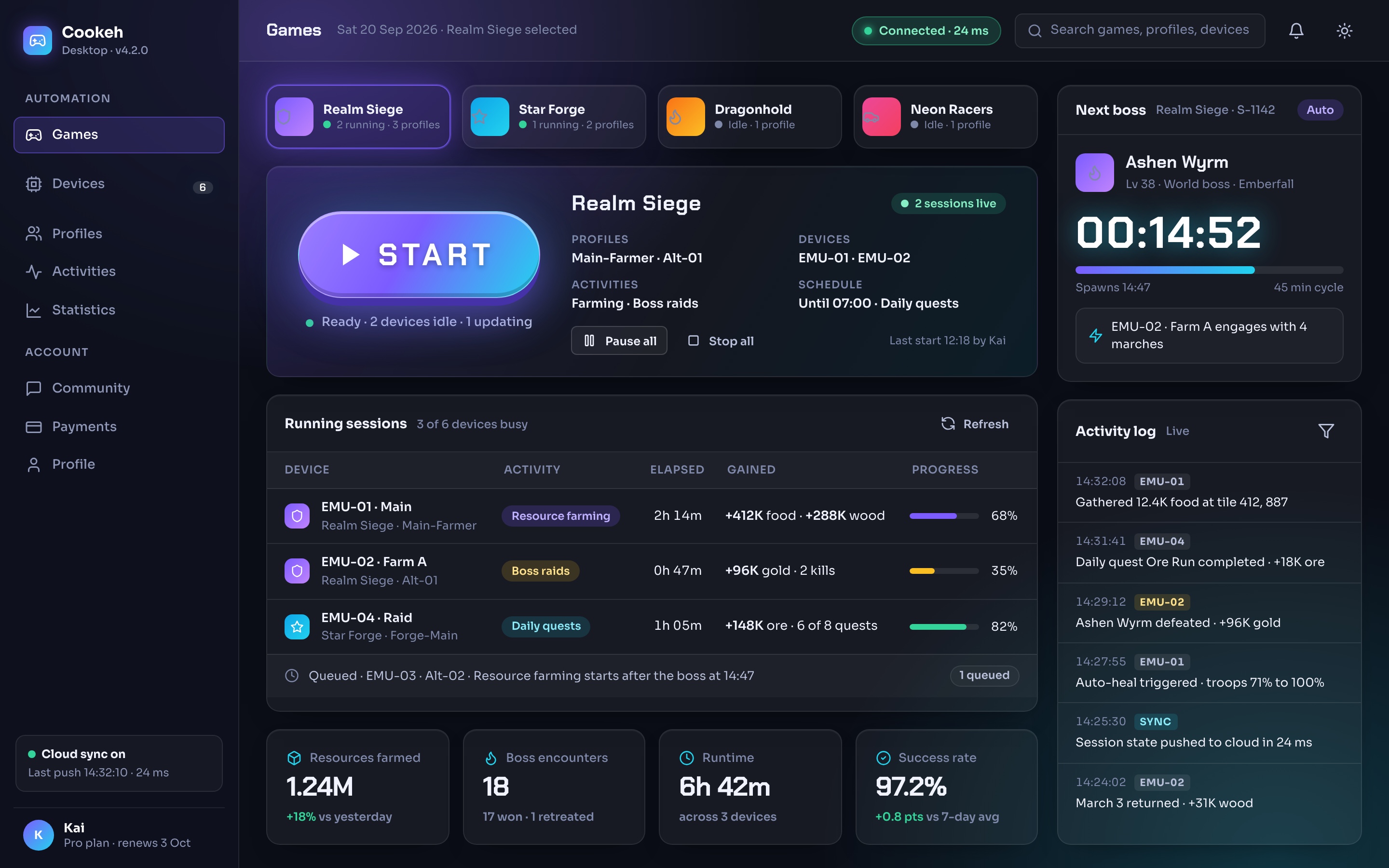
Cookeh Gaming Automation Platform
A Windows desktop application that emulates Android mobile games and automates in-game processes like resource farming a...